Real estate prices in Germany continued to rise in the third quarter of 2025. Prices for apartments and single-family houses increased noticeably, while multi-family houses became slightly cheaper. At the same time, transaction activity picked up sharply, in some segments even exceeding the levels seen during the boom years.
These insights are based on the latest update of the German Real Estate Index (GREIX), a joint project of the local expert committees for property values (Gutachterausschüsse für Grundstückswerte (GAAs)), ECONtribute, and the Kiel Institute for the World Economy (Kiel Institute). The GREIX tracks price developments in 24 cities and regions across Germany. All data are freely available at www.greix.de.
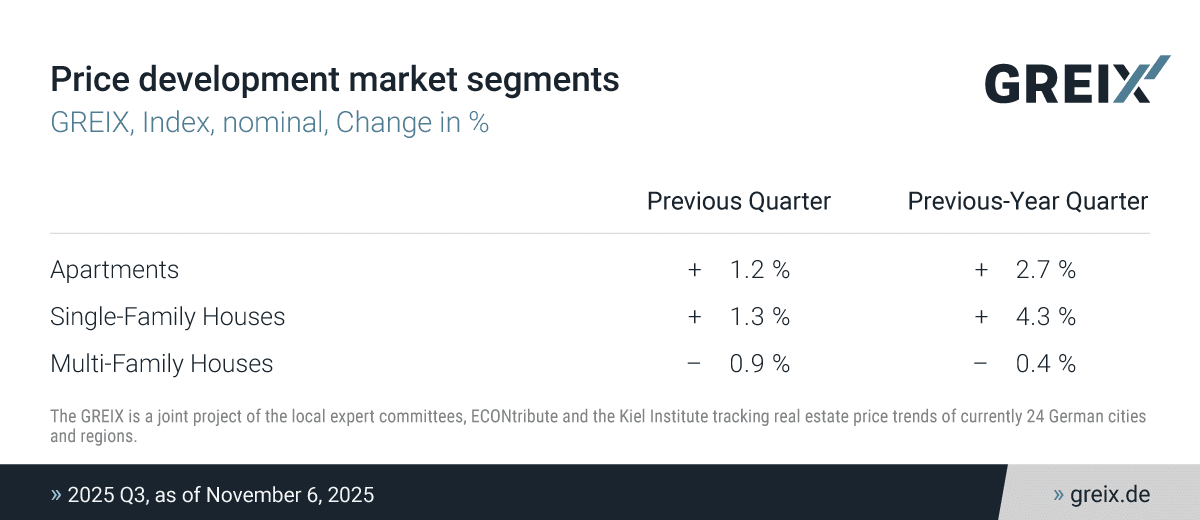
“The sharp increase in the number of transactions shows that many market participants seem to have adjusted to current conditions,” says Jonas Zdrzalek, real-estate market expert and project leader of GREIX at the Kiel Institute. “Overall, we are observing a moderate but stable upward movement in property prices.” Compared to the previous quarter (Q3 2025 vs. Q2 2025), apartment prices rose by 1.2 percent and single-family houses by 1.3 percent.
In contrast, multi-family houses were 0.9 percent cheaper. However, given the relatively low number of transactions in this segment, these figures are less conclusive. Measured in terms of current purchasing power—adjusted for inflation—apartments and single-family houses rose by around 0.7 and 0.8 percent, respectively, while multi-family houses fell by 1.4 percent.
New peaks in 2027?
A comparison to the same quarter of the previous year (Q3 2025 to Q3 2024) shows a noticeable upward trend. Apartment prices rose by 2.7 percent and single-family houses by as much as 4.3 percent. This means that, for the fourth and fifth quarters in a row, respectively, prices in these segments were already above the previous year-quarter level. The price of multi-family houses fell slightly (-0.4 percent). On a weighted national average, the prices of apartments, single-family houses, and multi-family houses were, respectively, just under 10 percent, just under 12 percent, and around 25 percent below their peaks. Assuming the current quarter’s growth rate for apartments persists, prices will not reach a new all-time high until late 2027.
The number of transactions rose sharply: Compared to the same period last year, the increases are in some cases in the double-digit range, with the most significant increase in the apartment segment, where 14 percent more purchases were recorded. Compared to the years 2019 to 2021, which represent the peak of the real estate boom, transaction figures were only slightly lower. In the single-family home segment, they were even 5 percent higher.
Comparison of major cities: Highest level in Leipzig
Developments varied across the eight largest cities. In a quarterly comparison, prices rose most significantly in Düsseldorf (+1.6 percent) and Leipzig (+1.0 percent), followed by Stuttgart (+0.6 percent). They stagnated in Frankfurt am Main and fell by 1.0 percent in Cologne.
No complete data was available for Berlin, Hamburg, and Munich for the third quarter.
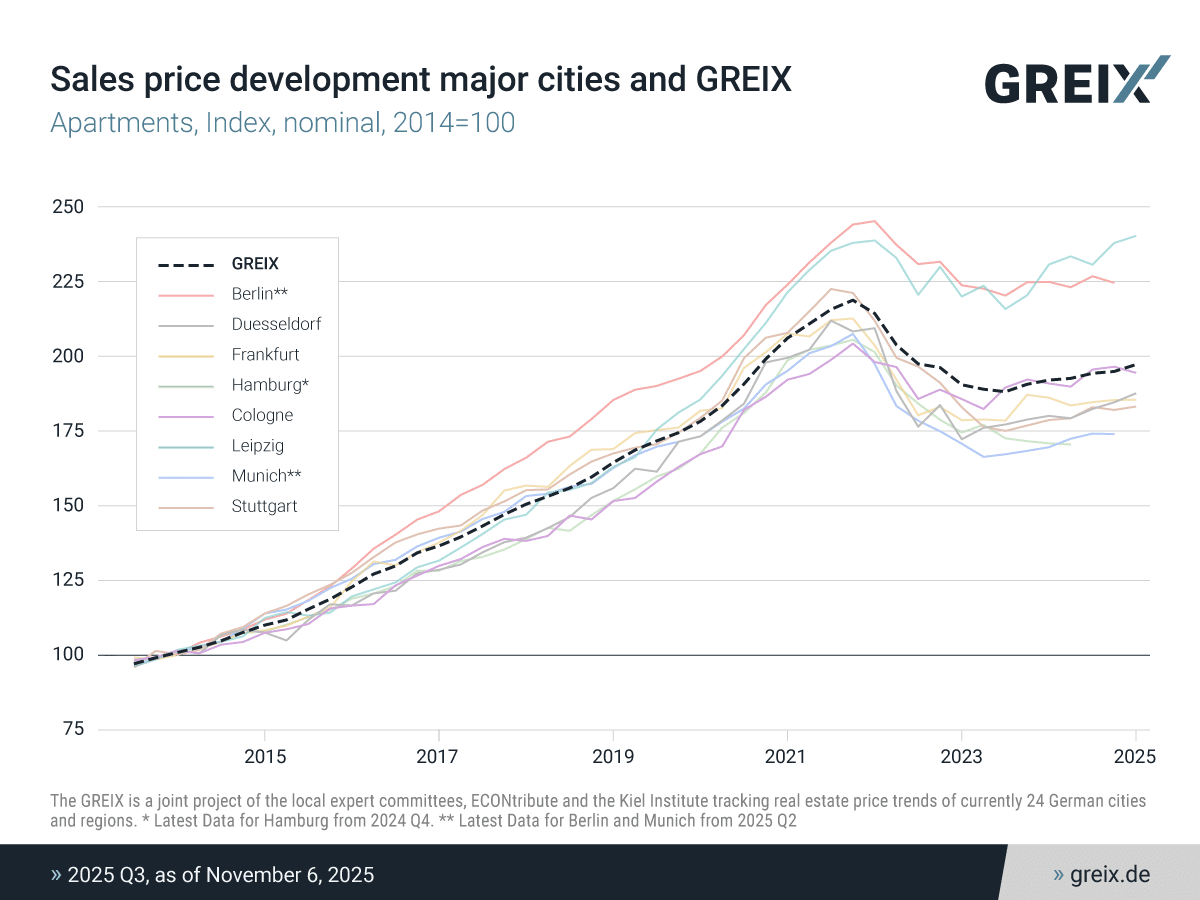
This means that prices in Leipzig reached a new all-time high, just under 1 percent above the peak of the real estate boom in mid-2022. In the other major cities, prices are still significantly lower in some cases. “Demand for housing is high and most indicators point to further price increases in the near future, despite the likely continuation of high mortgage rates,” says Zdrzalek.
About the GREIX
What is the GREIX?
The GREIX is a real estate price index for Germany based on the purchase price collections of local expert committees, which contain notarially certified sales prices. It tracks the price development of individual cities and neighborhoods back to 1960 and is based on over two million transactions. With the help of this dataset, long-term trends in real estate markets can be analyzed and current developments can be placed in a historical context.
What Data and Methods are Used to Create the Indices?
The local expert committees collect data on all real estate transactions. The price index is estimated using the latest scientific standards and statistical methods (hedonic regression method).
Who is Funding the GREIX?
The GREIX is funded through public grants and is a project of the DFG-funded Bonn-Cologne Excellence Cluster ECONtribute and the Kiel Institute for the World Economy (IfW Kiel) with the goal of increasing transparency in the real estate market. Various price indexes for 20 cities and regions are freely accessible at www.greix.de
The dataset will be gradually expanded to include more cities.